INSIDE THE BOOK
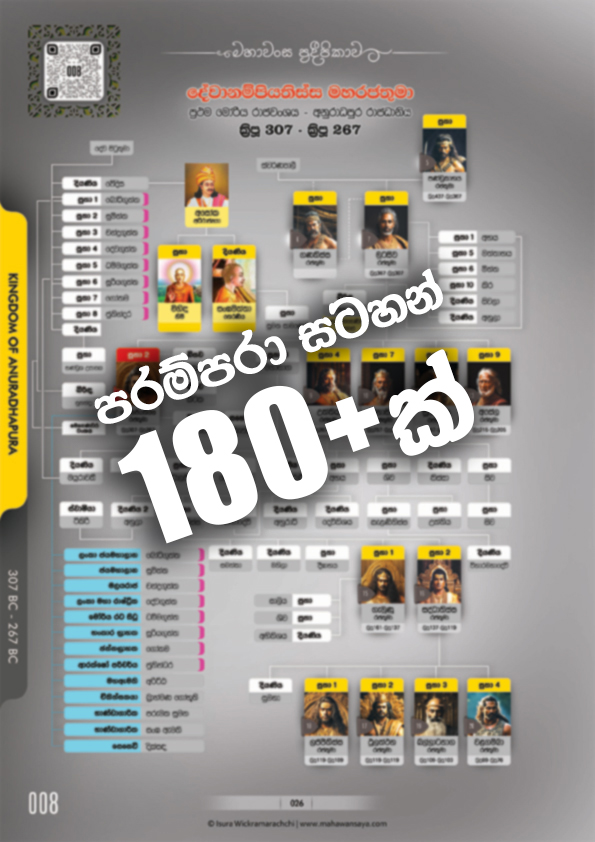
180+ Genealogical Charts
The Mahawansa Pradeepikawa comprises two principal sections, one of which is dedicated to the genealogical charts of Sri Lanka's monarchs. Featuring 194 monarchs, the book contains more than 180 genealogical charts, each extending at least two generations backwards and two generations forwards from the respective monarch. These charts have been carefully designed and systematically presented to ensure clarity and ease of understanding.
Through these genealogical charts, readers can gain a comprehensive understanding of the continuity of Sri Lanka's royal lineage, the relationships between monarchs and the succession of royal dynasties throughout history.
A distinctive feature of these charts is the specialised visual system used to indicate instances in which a monarch was responsible for the death of another individual. This approach enables readers to develop a broader understanding of the circumstances surrounding royal succession and the acquisition of power, while reconsidering certain historical misconceptions that have become widely accepted in contemporary society.
Furthermore, officials and other significant individuals associated with each monarch have also been incorporated into the respective genealogical charts. This allows readers to explore not only familial relationships but also the wider network of individuals associated with royal administration and historical events.
By studying these genealogical charts, readers can enrich their knowledge of Sri Lanka's royal dynasties, the monarchs belonging to each dynasty, and the complex relationships that shaped the country's royal history. Rather than studying monarchs as isolated historical figures, this approach enables readers to understand them within the broader context of an interconnected royal lineage spanning centuries.
Over 200 A4-Sized Realistic Portraits of Monarchs
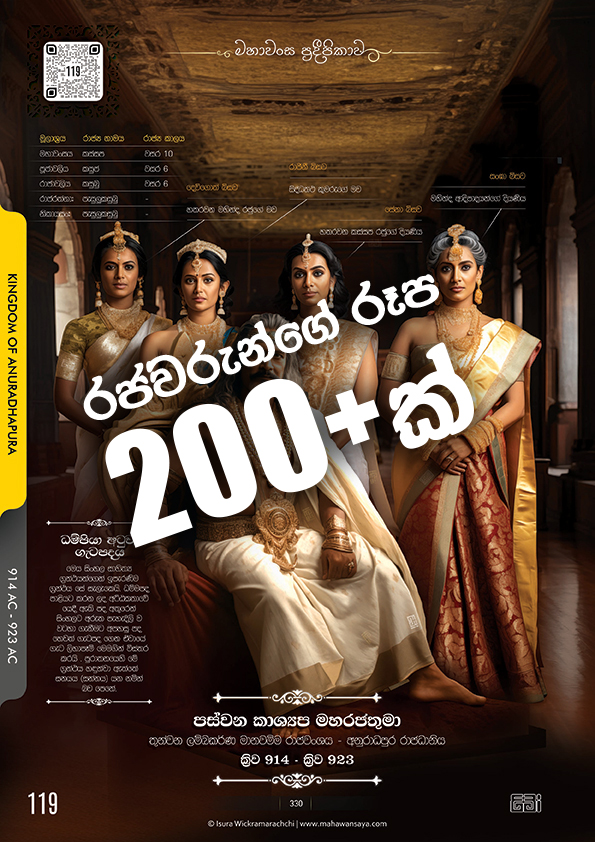
One of the distinctive features of Mahawansa Pradeepikawa is its collection of more than 200 realistic, full-colour, A4-sized portraits depicting Sri Lanka's monarchs. As explained in the “Technology” section, each royal portrait has been created following a careful study of various historical and cultural criteria.
During the creation of these portraits, particular attention was given to each monarch's personality, age, physical characteristics, period of reign, royal attire, jewellery, religious affiliations, style of governance and significant historical contributions. Efforts were also made to reflect, as accurately as possible, the architectural characteristics, cultural identity and environmental surroundings associated with each historical period.
Using Artificial Intelligence (AI) and digital image-editing techniques, more than 27,000 images were generated throughout this creative process. In certain instances, hundreds of images had to be created for a single monarch to achieve a portrayal that appropriately reflected their personality. From this extensive collection, more than 200 full-colour portraits that best represent the personalities and historical backgrounds of the monarchs were carefully selected for inclusion in this publication.
These portraits should not be regarded as definitive historical evidence of the actual physical appearance of the respective monarchs. Rather, they are artistic visual reconstructions developed through a combination of available historical sources, archaeological information, cultural characteristics and creative imagination.
One of the primary objectives of these illustrations is to establish a lasting visual impression of the monarchs in the minds of children, helping them remember royal names and their respective historical contributions more easily. Rather than limiting history to written descriptions, names and dates, my intention was to bring readers closer to the past through an engaging visual experience.
A concise account of the technological methods, historical criteria and creative processes employed in producing these portraits can be found in the “Technology” section of this publication.
Dedicated Pages with Detailed Source References
Mahawansa Pradeepikawa contains a dedicated information page for each monarch featured in the publication. In preparing these pages, my primary focus was on the genealogical relationships of Sri Lanka's monarchs. Alongside a concise introduction to each monarch, these pages provide details of their genealogical relationships, accompanied by references to the historical sources used to establish those connections.
In presenting these references, I have gone beyond conventional citation practices by adopting a simple and transparent approach that enables children, as well as readers unfamiliar with historical literature, to identify and consult the relevant sources with ease.
During my studies involving children, I realised that identifying historical sources presented through abbreviated references was often a challenging task. This difficulty is not limited to children but is also experienced by adult readers who are unfamiliar with historical publications and conventional referencing methods.
For example, when citing information from the Mahavamsa, a conventional reference may appear as “M.V. – Chapter 17”. Although readers may reasonably deduce that “M.V.” refers to the Mahavamsa, identifying less familiar abbreviations can be considerably more challenging. For instance, a reader without prior knowledge of historical literature may find it difficult to recognise that the Sinhala abbreviation “ස. පා.” refers to the Samantapasadika.
One of my fundamental objectives in creating Mahawansa Pradeepikawa was to enable children to acquire historical knowledge without unnecessary difficulty. Accordingly, when presenting source references, I have taken particular care to clearly specify the full title of the publication, the author's name, volume number, page number or relevant chapter, wherever applicable. When audiovisual materials have been consulted, the programme title, broadcasting channel, episode number and relevant timestamp have also been provided.
Examples:
- Savistara Mahavamsa Anuwadanaya, Volume 2 – Professor Mangala Ilangasinghe – Page 156.
- Sinhala Rajavamshe, Volume 2 – Venerable Ellawala Medhananda Thero, Puravidya Chakravarti – Page 211.
- Maha Sinhale Bauddha Ithihasaya – The Buddhist Television Channel – Episode 154 – From the 25-minute mark onwards.
This referencing system enables readers not only to study the information presented in the book but also to independently consult the original sources, compare historical accounts and undertake further research.
I believe that this approach will particularly encourage children to develop critical thinking skills and cultivate the habit of studying history through documented sources. By providing them with the means to independently examine and substantiate historical information, I hope to strengthen both their confidence in the knowledge they acquire and their ability to verify it.
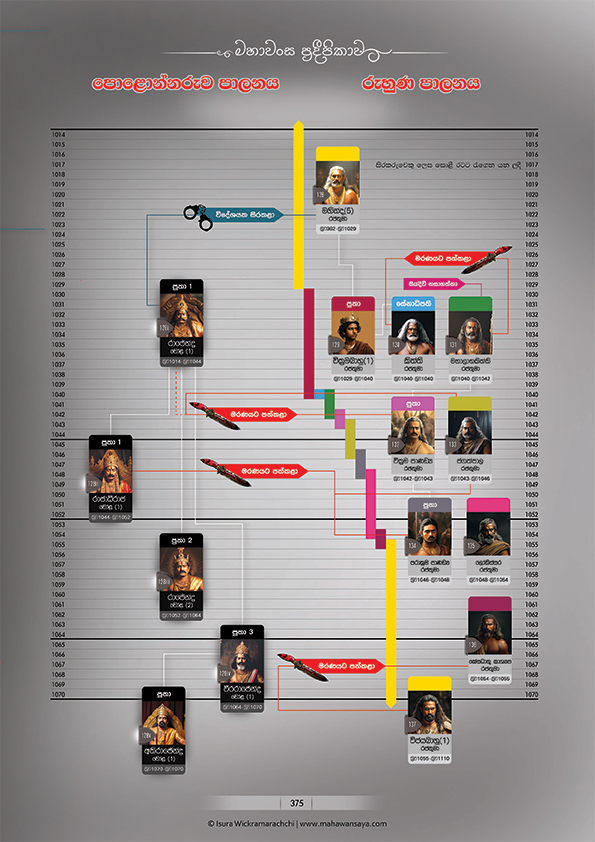
Historical Timeline Charts
Several historical timeline charts have been incorporated into Mahawansa Pradeepikawa to facilitate a clearer understanding of Sri Lanka's political and royal history. These charts have been specifically designed to illustrate concurrent systems of governance that existed in different regions of the island during the same historical period.
Throughout Sri Lanka's history, the entire island was not always governed by a single monarch or under a single kingdom. During certain historical periods, different regions of the island were governed by separate rulers. Gaining a comprehensive understanding of such concurrent administrations may be difficult through a conventional chronological list of monarchs alone.
For example, a comparative timeline illustrates the rulers who governed Ruhuna during the period when the northern regions of the island came under Chola rule following the invasion of the Anuradhapura Kingdom. This enables readers to easily identify the rulers who governed different regions during the same historical period, their respective periods of rule and the chronological relationships between their administrations.
These timeline charts allow readers to compare the reigns of different monarchs, understand how political authority was divided across the island and develop a broader understanding of the political transformations that occurred between kingdoms.
I believe that this approach will be particularly beneficial to children, enabling them to visually understand the chronological relationships between historical events rather than merely memorising dates and periods of reign. Through these visual representations, the study of Sri Lanka's royal history becomes more systematic, accessible and meaningful.
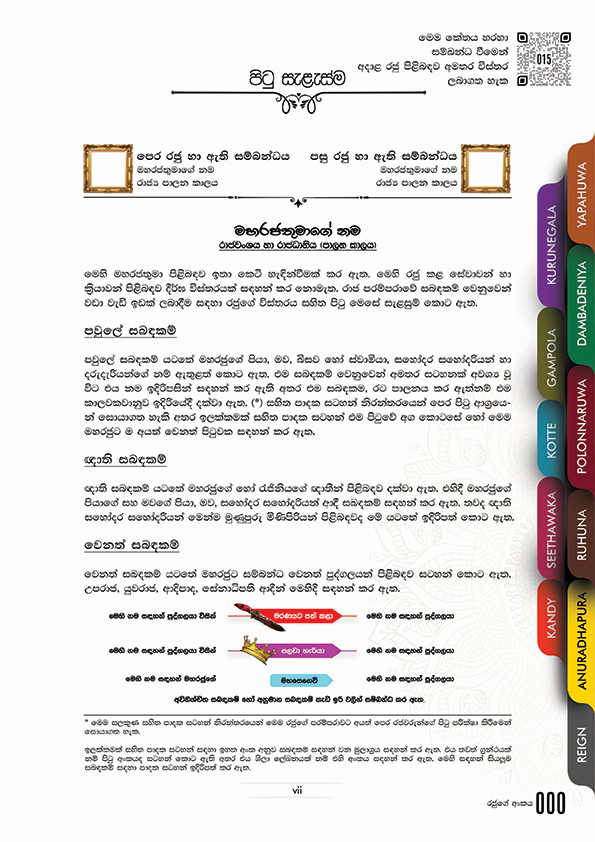
Page Layout and Design
A detailed introduction to the page layout and the manner in which information is presented in Mahawansa Pradeepikawa has been included at the beginning of the book. This enables readers to gain a clear understanding of the publication's structure and its method of presenting historical information before exploring its contents.
This section explains the genealogical charts, Royal Numbers, colour codes, QR codes, periods of reign, source references and the various symbols and markings used to represent different relationships. It also familiarises readers with the purpose of each section within a page and the type of information presented therein.
By maintaining a consistent page layout throughout the publication, readers can locate the information they require quickly and conveniently, while also comparing historical details relating to different monarchs.
In designing this page layout, I made a particular effort to enable children to explore and study the book independently, without requiring guidance from others. Therefore, familiarising themselves with this introductory section before exploring the book will enable readers to make the fullest use of its historical content and distinctive features.
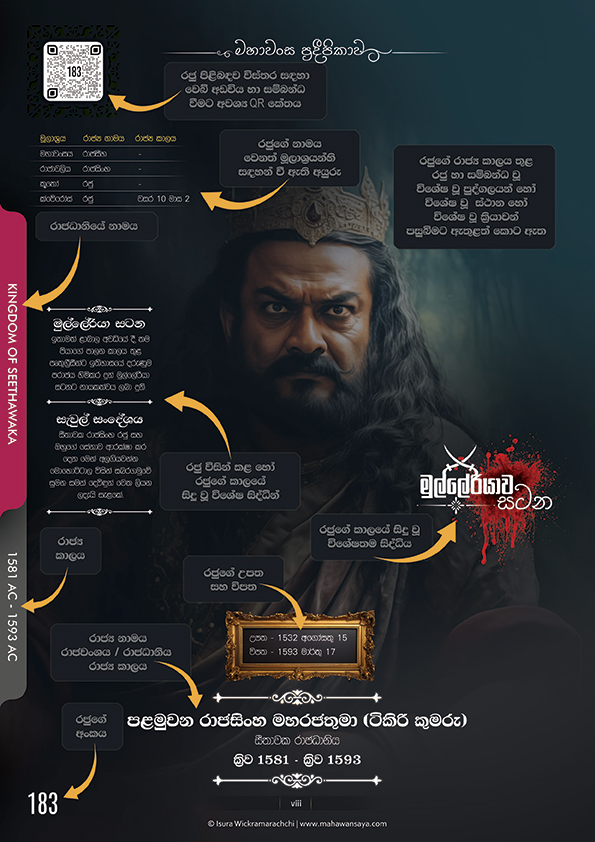
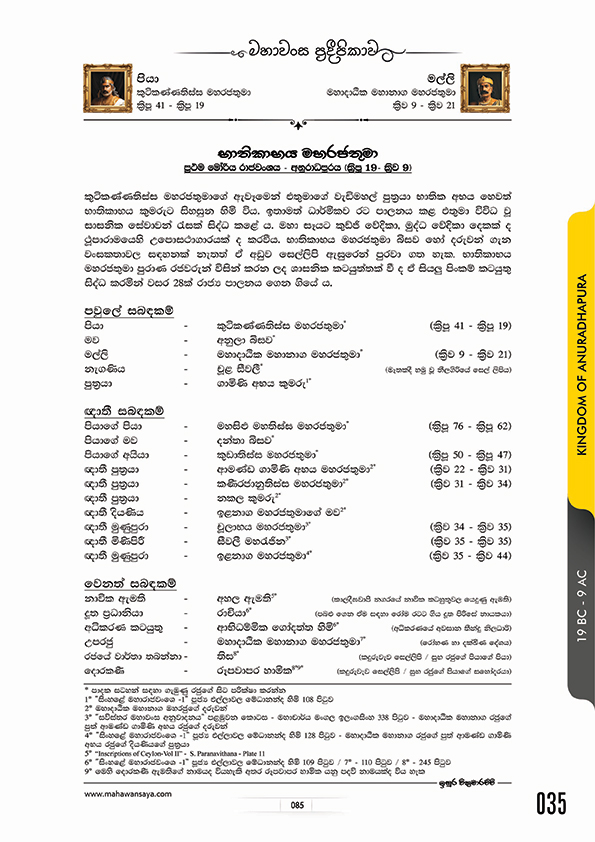
Royal Portrait Page Layout
This section explains the layout of the pages featuring realistic, full-colour portraits of monarchs in Mahawansa Pradeepikawa, together with the manner in which the accompanying historical information is presented.
Rather than being limited to a royal portrait, each page has been carefully designed to provide readers with a collection of essential historical information about the respective monarch. This includes the monarch's principal name, alternative names recorded in various historical sources, period of reign and information concerning regnal dates recorded in major historical sources.
Furthermore, each page contains concise information about significant historical events that occurred during the monarch's reign, notable achievements and contributions, and important individuals associated with the monarch's life and administration.
The Royal Number, the colour code identifying the respective kingdom and the unique QR code providing access to additional historical information are also distinctive features incorporated into these pages.
My primary objective in designing this page layout was to establish a connection between the visual representation of each monarch and the essential historical information associated with them. Through this approach, readers can gain a fundamental understanding of a monarch's personality, period of reign and historical significance by exploring a single page, making the study of Sri Lanka's royal history more accessible, engaging and memorable.